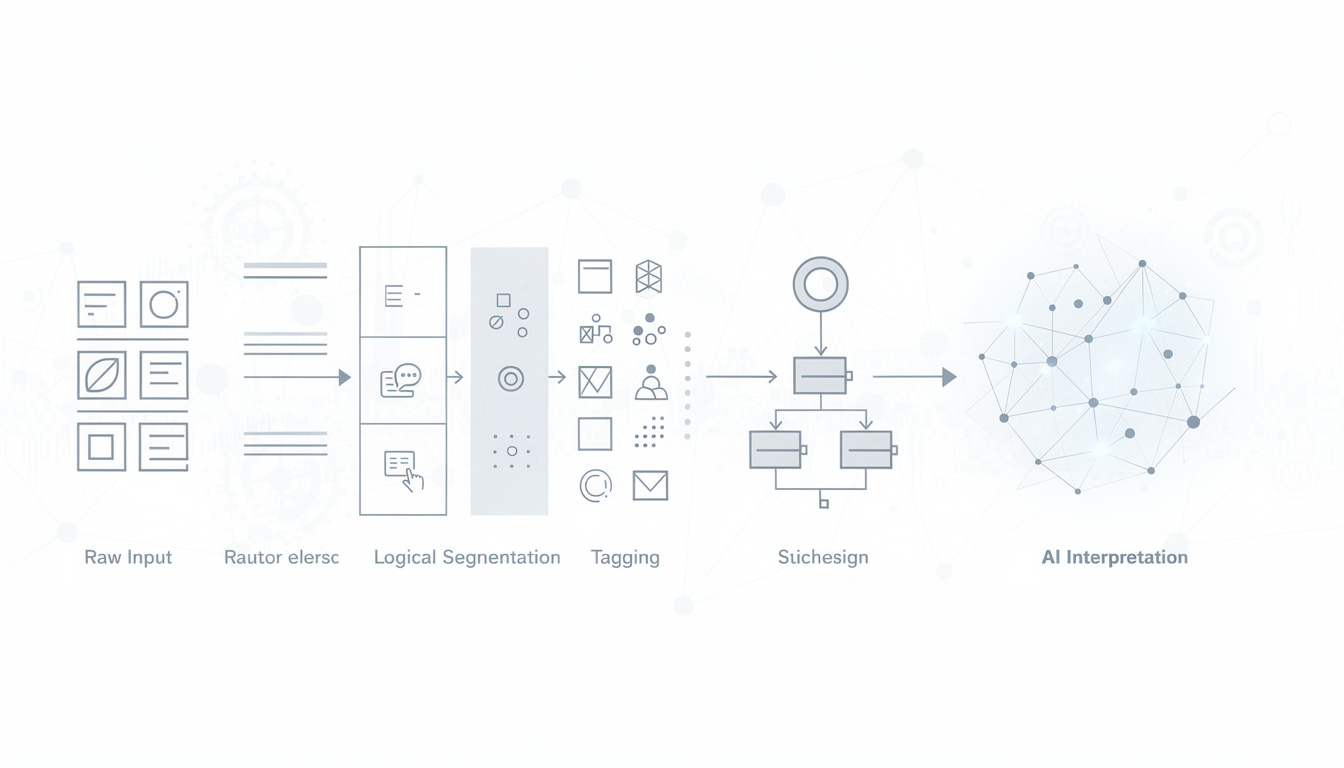
Definition and Role of Content Structuring in Artificial Intelligence
Structuring content, in the context of artificial intelligence, consists of organizing information into clear, logical blocks that are easily interpretable by AI algorithms. This organization goes far beyond simple formatting for human readers: it aims to make the content immediately exploitable by automated systems, especially those based on language models and generative response engines.
Content structuring notably involves the use of semantic tags, the integration of precise metadata, as well as the segmentation of information into accessible hierarchical sections. For an AI, this type of architecture facilitates content recognition, rapid indexing, and above all, the reliable retrieval of information in a synthesized and relevant format.
This approach is essential in the era of Generative Search Optimization (GSO), an evolution of traditional SEO where the goal is no longer limited to ranking in a search engine but extends to the ability to be cited and used as a source in responses generated by artificial intelligences. Content structuring thus plays a dual role: serving humans by offering clear and accessible text, and serving machines by providing structured data ready to be interpreted by AI algorithms.
The granular nature of structured content, divided into small segments enriched with metadata such as keywords and categories, allows AI to precisely identify relationships and contexts, avoiding comprehension errors caused by unsegmented monolithic text. It’s somewhat like providing the machine with a detailed map rather than a confusing manuscript.
| Aspect | Description | Usefulness for AI |
|---|---|---|
| Granular blocks | Segmentation into short and homogeneous segments | Facilitates partial reading and parallel processing |
| Metadata | Labels, keywords, dates, authors | Provides context and enhances response accuracy |
| Semantic tags | Use of HTML5, schema.org, etc. | Allows AI to identify the nature and role of content |
| Hierarchy | Clear organization of titles and subtitles | Guides understanding of relationships between sections |
- Improve precise information retrieval
- Facilitate contextual understanding within AI algorithms
- Simplify data segmentation for automatic processing
- Ensure scalability and easy content updating
How AI Algorithms Work in Interpreting Structured Content
AI algorithms, notably language models like ChatGPT or Gemini, work by analyzing and synthesizing large quantities of text to provide a relevant response. The quality of their interpretation strongly depends on how the content is presented and structured. Text without clear organization can cause analysis errors or poor context consideration.
To understand more concretely, imagine an AI trying to answer a question. It must first recognize important entities in the content, their relationships, then synthesize the information coherently. When data is segmented into well-tagged blocks and enriched with metadata, AI can:
- Quickly identify relevant parts based on the query context.
- Link sections together to construct a complete and nuanced answer.
- Access reliable source information thanks to integrated metadata and citations.
- Avoid confusion generated by overly dense or hierarchically unclear texts.
Moreover, semantic HTML text formatting greatly facilitates this automatic reading. The judicious use of tags like <h2>, <h3>, <p>, but also specific tags like schema.org indicates to AI the exact nature of the content (FAQ, article, testimonial, etc.).
This principle is particularly relevant for systems that practice semantic indexing, where the machine no longer only ranks keywords but tries to understand the overall meaning and intention behind the content. Organized structuring serves as a clear interface here so that AI grasps meaning with precision and minimal erroneous interpretations.
| Step | AI Action | Decisive Advantage |
|---|---|---|
| Block extraction | Separation of content into distinct elements | Allows targeted selection based on the query |
| Metadata analysis | Use of keywords, authors, dates | Ensures relevance and currency of data |
| Hierarchical understanding | Interpretation of title and section levels | Guides logical construction of the answer |
| Synthesis | Construction of a summarized sentence or paragraph | Provides a clear and concise answer to the user |
- Preference for recent, well-sourced, and reviewed content
- Need for explicit structure for contextual understanding
- Increased ability to distinguish and cite precise sources thanks to tags
- Facilitation of dynamic knowledge updating
Step-by-Step Method to Structure AI-Optimized Content
Implementing effective structuring to be used by an AI requires following a clear and rigorous approach. Here is a detailed method designed to maximize both user experience and machine readability:
- Identification of objectives: understand the intentions of readers and AIs. Clearly define the subject and the typical queries the content should address.
- Decomposition into blocks: organize content into distinct sections (titles, paragraphs, lists). Each block should address a precise idea, easy to analyze by a machine.
- Integration of semantic tags: use appropriate HTML tags (
<h2>,<h3>,<ul>, etc.) to hierarchize information. Add data withschema.org, notably types like FAQ, Article, HowTo. - Clear and concise writing: prefer short sentences, simple language, and avoid unnecessary jargon. Ensure each piece of information is well contextualized and sourced.
- Enrichment with metadata: add keywords, publication dates, author references, and links to reliable sources. This strengthens trust and credibility in the eyes of AI algorithms.
- Validation and testing: query AIs like ChatGPT on the covered topics to verify that the content is well understood and reused. Adjust structure and content if necessary.
This method is essential for any business or content creator wishing to ensure visibility in responses generated by artificial intelligence, beyond the simple classic results of search engines.
| Phase | Main Action | Recommended Tools |
|---|---|---|
| Planning | Define objectives and audiences | Query analysis, market studies |
| Structuring | Create blocks, hierarchy, tagging | HTML editors, SEO GSO plugins |
| Optimization | Clear writing, metadata, citations | SEO tools, semantic annotators |
| Control | Testing via AI, adjustments, and updates | Query ChatGPT, Perplexity, Gemini |
- Never sacrifice human readability to please bots
- Balance information density and text simplicity
- Use FAQs to answer common questions of AIs and users
- Update content regularly to follow algorithm evolution
Common Mistakes to Avoid in Content Structuring for AI and Their Impact
Despite technological advances, some classic pitfalls remain in structuring content intended for artificial intelligence. Ignoring these aspects can compromise the visibility and relevance of your content in generated results.
Among the most common mistakes are:
- Unstructured or too monolithic content: AIs struggle to extract relevant information, resulting in incomplete or erroneous answers.
- Absence or poor use of semantic tags: without clear indication, the algorithm struggles to recognize the nature of information (FAQ, article, testimonial) and to hierarchize data.
- Excessive tagging overload: wanting to “over-optimize” with too many tags or metadata can drown the quality signal and make content less readable, both for humans and machines.
- Using language that is too technical or verbose: AIs favor clarity and conciseness. Complex and convoluted sentences can reduce indexing effectiveness.
- Ignoring regular updating: outdated content is seldom cited, as AI engines favor up-to-date references.
A concrete example illustrates these points. A site in the natural health domain had rich content but presented as long PDF documents without appropriate HTML structure. Although the information was relevant, it was never cited by engines like Gemini. After conversion into web pages with schema.org tags and creation of targeted FAQs, the site became a reference in several AI summaries.
The balance between classic SEO optimization and GSO must also be respected. Excessive keyword stuffing not only harms human quality but degrades the potential for being reused by AI, which values coherence and textual fluidity.
| Common Mistake | Consequence for AI | SEO/GSO Impact |
|---|---|---|
| Unstructured content | Interpretation and indexing difficulties | Loss of AI and SEO visibility |
| Incorrect or missing tags | Loss of context and hierarchy | Fewer citations by AI |
| Tagging overload | Signal confusion | Reduced overall effectiveness |
| Overly technical language | Poor understanding | Low reuse in summaries |
| Unupdated content | Rejections or low weighting | Degraded visibility |
- Avoid overly dense and complex content without segmentation
- Prioritize clear and suitable tags for the content’s nature
- Moderate metadata quantity to maintain a strong signal
- Adopt a clear and accessible style
- Schedule regular content updates
Concrete Examples of Structured Content and Their Influence on AI Visibility
Several practical cases demonstrate the importance of structuring in AI optimization and referencing in 2025. The gradual shift from SEO to GSO requires adopting specific practices.
For example, an e-commerce store specializing in shoes developed an enriched product sheet:
- Clear presentation of features in lists
- Detailed FAQ on shoe care and selection
- schema.org tagging of type Product and FAQ
- Addition of technical metadata (size, material, brand)
- Referencing of customer reviews with Review tags
This approach led to a significant increase in citations in responses provided by ChatGPT and Perplexity for queries such as “how to care for white sneakers?” or “best shoe choice for sports.” Content structuring allowed AI algorithms to better index and exploit each element, increasing the site’s credibility and visibility.
Another example in the tourism domain where a site adopted a strategy based on GEO structuring (Generative Engine Optimization). By anticipating common user questions and integrating appropriate content schemas (details on GEO), it saw its traffic from AI engines triple in less than a year. Rigorous organization of modular, tagged data played a key role.
| Use Case | Applied Practice | Identified AI Result |
|---|---|---|
| Shoes E-commerce | Enriched product sheets + FAQ + Product/Review tagging | Primary source cited by AI for specific queries |
| Tourism and GEO | Modular structuring + use of GEO optimization | AI traffic tripled, better visibility in chatbots |
| Natural health blog | Conversion from PDF to structured HTML content with FAQ | Increased citations in Gemini and ChatGPT |
- Clearly hierarchized and segmented content more easily attracts AI attention
- Implementing FAQs and adapted schemas directly improves citation capacity
- HTML format enriched with structured data is essential against the rise of generative bots
- Anticipating user needs and editorial clarity remain major priorities

