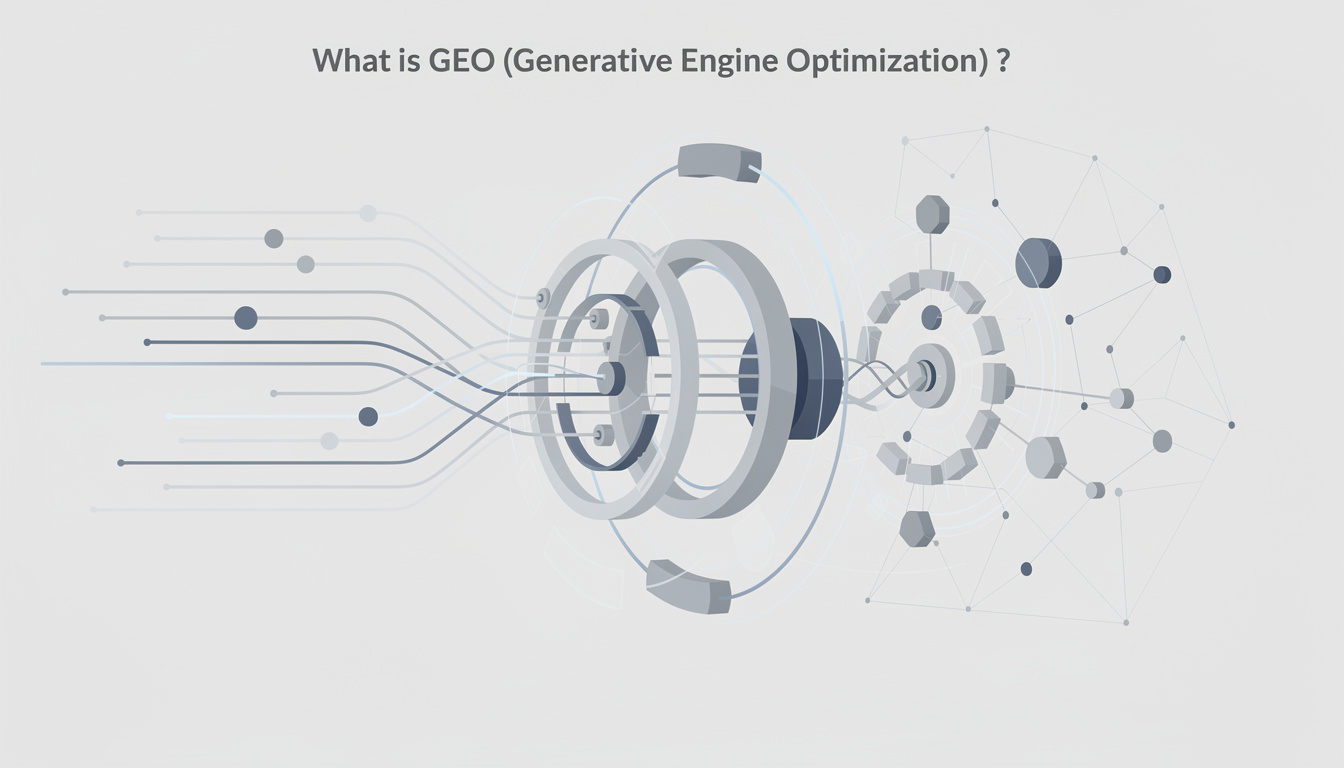
Clear Definition and Foundations of Generative Engine Optimization (GEO)
Generative Engine Optimization, commonly abbreviated as GEO, is a new discipline that extends traditional natural referencing (SEO) but is specifically adapted to search engines powered by generative artificial intelligence. While SEO aims to position a website in classical result lists, GEO’s goal is to optimize the visibility of content within the synthetic answers provided by large language models (LLM) and generative engines such as ChatGPT, Google Gemini, Claude, or Perplexity.
In this context, GEO involves working the content so that artificial intelligences identify, synthesize, and directly cite the information elements derived from this content in their answers. This optimization mode therefore focuses on authority, contextual relevance, and semantic clarity, so that the content becomes a recognized reference source by generative AI algorithms.
More precisely, GEO encompasses techniques that increase the probability that one’s content is selected, reformulated, and then integrated into the answers provided by generative engines during user queries. It is no longer about attracting a click to a site, but about being quoted or mentioned within the answer itself, which constitutes a major change in the approach to digital referencing in the AI era.
- Specific optimization for AI-generated answers
- Adapting content for better understanding by language models
- Emphasis on clarity, authority, and semantic structure
| Aspect | Traditional SEO | GEO (Generative Engine Optimization) |
|---|---|---|
| Main objective | Position the site in classical results | Be cited in generative engine answers |
| Key metrics | Position in SERPs, click-through rates, traffic | Citation rate, citation quality, AI visibility |
| Preferred content type | Web pages optimized with keywords and backlinks | Clear, structured content rich in original data |
The term “Generative Engine Optimization” was formalized at the end of 2023 thanks to a seminal scientific article, thus marking the academic recognition of this innovative approach. Since then, the discipline has grown, notably with the rise of conversational assistants and other engines responding by informational synthesis, profoundly changing user search habits and companies’ digital marketing strategies.
Functioning and Underlying Mechanisms of Generative Engine Optimization
Understanding how generative engines work is essential to grasp why and how GEO operates. These next-generation search engines rely on advanced language models capable of assimilating the user query, collecting information from numerous sources in real-time or from internal databases, then producing a coherent and structured synthetic response.
The process breaks down into several key steps:
- Query analysis: The posed question is broken down into units of meaning, or tokens, allowing its intent to be captured.
- Information retrieval: The engine explores its internal databases, performs contextualized web crawls, sometimes in real-time.
- Extraction and comprehension: It identifies relevant pieces of information, transforming them into vector representations to facilitate semantic understanding.
- Synthesis: The AI generates a smooth, clear, and concise answer, integrating multiple sources.
- Citation and transparency: The most reliable and relevant sources are mentioned to legitimize the response.
GEO intervenes at each stage. It’s not just about having quality content, but especially that this content is structured and written in such a way that algorithms quickly understand its subject, context, and key points. Implementing appropriate semantic markups (like Schema.org) and a clear logical architecture is fundamental.
Moreover, the evaluation criteria for sources by AI algorithms include:
- Semantic relevance and clarity of content
- Authority and credibility, measured by author reputation, update frequency, and presence of tangible evidence
- Content freshness, especially in rapidly evolving fields
- Completeness, with detailed coverage anticipating related questions
- Presence of structured data favoring indexability
These elements allow GEO-optimized content to be recognized as a reference in the information aggregation ecosystem of dialog-based artificial intelligences. The technical detail and finesse of markup facilitate their task and encourage citation.
| Process step | Role of GEO content | Expected impact |
|---|---|---|
| Tokenization and analysis | Use of clear, appropriate, and natural language | Better understanding of the query and intent |
| Research and extraction | Well-structured content, citations, original data | Increased relevance perceived by AI |
| Synthesis and response | Synthetic information, clear summary, key points | Inclusion in generated response with explicit mentions |
These mechanisms explain that GEO cannot be effective without perfect adaptation of content to the requirements of generative engines, an aspect that differs significantly from classic SEO.
Practical Methods to Implement Effective GEO Optimization
Implementing a high-performance GEO strategy relies on a series of specific actions aimed at making content not only visible but also directly usable by generative AI engines. The key steps are as follows:
- AI Visibility Audit: Identify current presence in answers from engines like ChatGPT, Claude, Gemini, and Perplexity on strategic queries.
- Technical optimization: Implement Schema.org markup adapted to your content, ensure clear page architecture (hierarchical H2, H3 titles) and avoid blocking AI crawlers.
- Content structuring: Produce organized content with TL;DR summaries, bullet lists, and short paragraphs, each section addressing a precise intent.
- Creation of rich and contextualized content: Integrate original data, studies, figures, and anticipate related questions to provide comprehensive answers.
- Maintaining freshness: Regularly update content to guarantee relevance and currency.
- Monitoring and adjustments: Measure citation rates, quality of representation in AI responses, and continuously optimize the strategy.
Writing quality remains at the heart of the process. Working with experts capable of ensuring fluid, clear, and detailed content is essential. For example, a digital marketing company aiming to be recognized by Claude will benefit from an in-depth and nuanced article, while for ChatGPT, a clear summary with key points will be an asset.
Finally, structured data plays a crucial role. Here are some essential types of markup:
- Article: for informational content
- FAQPage: for frequently asked questions
- HowTo: for practical guides
- Organization or Person: to attest authority
| Step | Concrete actions | Expected results |
|---|---|---|
| AI Audit | Analysis of your citation rate across several engines | Identification of gaps and opportunities |
| Structure optimization | Implementation of hierarchical titles, JSON-LD markup | Facilitation of AI interpretation |
| GEO-first writing | Clear content, lists, original data | Improved probability of inclusion in AI answers |
| Monitoring | Regular follow-up of KPIs (citation rates, position) | Continuous strategic adjustments |
A well-executed strategy thus allows boosting visibility in the generative engine ecosystem, often faster than with classic SEO. Many professionals nevertheless recommend integrating GEO as a complementary layer and not as a replacement for traditional natural referencing.
Common Mistakes to Avoid in a Generative Engine Optimization Approach
Despite its relatively recent emergence, GEO already faces recurring pitfalls that should be anticipated to maximize chances of success. Here are some classic mistakes observed in the digital marketing environment:
- Ignoring complementarity with SEO: Some mistakenly believe that GEO replaces SEO. In reality, the two approaches feed each other and perform better combined.
- Excessively long or poorly structured content: Dense text without clear titles or summaries becomes difficult for synthesis algorithms to use.
- Lack of semantic markup: Neglecting Schema.org markup limits AI’s ability to understand the nature and context of content.
- Ignoring content freshness: Not regularly updating information leads to lost credibility with generative engines, which prioritize recent data.
- Focusing only on keywords: GEO prioritizes quality, clarity, and depth rather than raw keyword density.
- Not adapting to platform diversity: Each AI engine has its own specificities and audiences, like ChatGPT, Claude, or Perplexity, which must be taken into account.
For example, a company that does not regularly update its content while producing a lot of text risks being completely ignored by generative engines that favor reliable and updated sources. Another common mistake is lack of clear structuring, making extraction and synthesis tasks complex for AIs.
| Common mistake | Consequence | Recommended solution |
|---|---|---|
| Confusing GEO with SEO replacement | Overall loss of marketing effort effectiveness | Integrate GEO as a complement to SEO |
| Content too voluminous and disorganized | Difficulty for AIs to extract key information | Structure content with titles, bullets, summaries |
| Omission of semantic markup | Lesser understanding and visibility | Implement appropriate Schema.org and JSON-LD |
| Lack of content updates | Loss of authority and visibility | Regularly update articles |
To avoid these pitfalls, it is strongly advised to rely on an integrated methodology and, if possible, to seek the expertise of professionals who master the subtleties of natural referencing and AI optimization.
Concrete Examples and Real Effects of GEO on Digital Marketing and SEO
The impact of Generative Engine Optimization on digital marketing strategies in 2025 is tangible and measurable. Several practical cases illustrate the concrete benefits obtained:
- A French digital agency case: By integrating GEO from early 2024 into its strategy, it saw the citation rate of its content rise from 10% to over 45% in answers generated by ChatGPT and Gemini, leading to a significant increase in qualified leads.
- A B2B software company: Thanks to a complete GEO optimization including advanced markup, expert technical content, and frequent updates, it reached first position in Perplexity citations on strategic sector queries.
- A consumer electronics brand: Experienced indirect traffic growth by improving visibility in AI answers, thus complementing its classic SEO presence, with a positive impact on sales and brand awareness.
These examples demonstrate that work on clarity, structure, and content freshness generates a virtuous circle where each citation strengthens credibility with AI algorithms. In comparison, neglected contents rapidly lose visibility.
| Company | GEO actions implemented | Results obtained |
|---|---|---|
| French digital agency | Structural optimization + markup + GEO-first content | Fourfold increase in citation rate, increased qualified leads |
| B2B software | Technical content, frequent updates, markup | Position 1 in sector AI citations |
| Consumer brand | SEO + GEO mix, simplified and up-to-date content | Indirect traffic growth, increased conversions |
The integration of GEO does not aim to completely replace visits to a website, but it offers a new exposure channel, very complementary to SEO. Indeed, an AI recommendation in a narrative answer generates immediate trust, higher than that of a simple web link, which favors long-term conversion rates.
This evolution requires a strategic vision where content is conceived from its origin not only for SEO but also for generative engines, thus sustainably conditioning success in digital marketing.
Differences between GEO and SEO: Perceptions, Strategies, and Professional Realities in 2025
Many still confuse SEO with GEO, although these two disciplines share similar objectives. It is, however, crucial to understand their differences, synergies, and how they complement each other in professional practice.
Fundamental Differences between SEO and GEO
The major distinction lies in how results are generated and presented:
- SEO: It involves optimizing a website or page so that it appears in a list of results, generally in the form of clickable links.
- GEO: The goal is to appear in a synthetic answer generated directly by an AI, where information is presented without requiring a click to another resource.
Another important difference to note:
| Parameter | SEO | GEO |
|---|---|---|
| Optimization criteria | Keywords, backlinks, speed, UX | Semantic clarity, hierarchical structure, original data |
| User behavior | Search and click to a site | Direct interaction with an AI answer |
| Time to results | 3 to 6 months | A few weeks |
Professional Complementarity and Strategic Synergies
In practice, a successful digital marketing strategy integrates both traditional SEO and GEO. Well-ranked content on Google is more likely to be recognized and cited by generative engines, as these often rely on already valued sources.
Success therefore depends on an integrated approach:
- Maintain a solid technical base (speed, accessibility, structure)
- Develop the production of rich, original, and frequently updated content
- Apply appropriate markup to facilitate exploitation by artificial intelligences
- Measure and analyze performance on both SEO and GEO fronts
SEO professionals who adapt to GEO enrich their skills, notably in understanding AI algorithms and language models, while generative optimization experts broaden their scope toward classic natural referencing practices.
For beginners, it is advised to document themselves on optimized web development, advanced markup, as well as the evolutions of generative engines to configure adapted and sustainable strategies.
| Comparison | SEO | GEO |
|---|---|---|
| Objectives | Maximize traffic by clicks | Maximize visibility in AI answers |
| Keywords | Targeted optimization with specific density | Natural, conversational use, differentiating words |
| Backlinks | Indispensable for authority | Complementary; remain important for AI credibility |
| Content | Variable quality depending on SEO research | Clear, explicit content, rich in structured data |
Why is GEO becoming important in digital marketing?
GEO responds to the evolution of search behaviors, with more and more users preferring answers from generative AIs. Ignoring this trend can lead to a significant loss of visibility among these emerging audiences.
Does GEO replace traditional SEO?
No, GEO and SEO are complementary. While SEO generates traffic through clicks, GEO aims to be cited in AI answers. They work better in synergy for a complete digital strategy.
What are the essential factors to optimize content in GEO?
Semantic clarity, a well-hierarchized content architecture, the use of original data, semantic markup (Schema.org), and regular information updates are key elements.
Which platforms are concerned by GEO?
Main generative engines like ChatGPT, Claude, Google Gemini, Perplexity, and Bing Copilot are the major platforms where GEO is deployed. Each has its own specificities and audiences.
Are there tools to measure GEO effectiveness?
Yes, several specialized tools like Otterly AI, Peec AI, or getSAO allow monitoring a brand’s presence in generative answers and analyzing GEO performance.

